
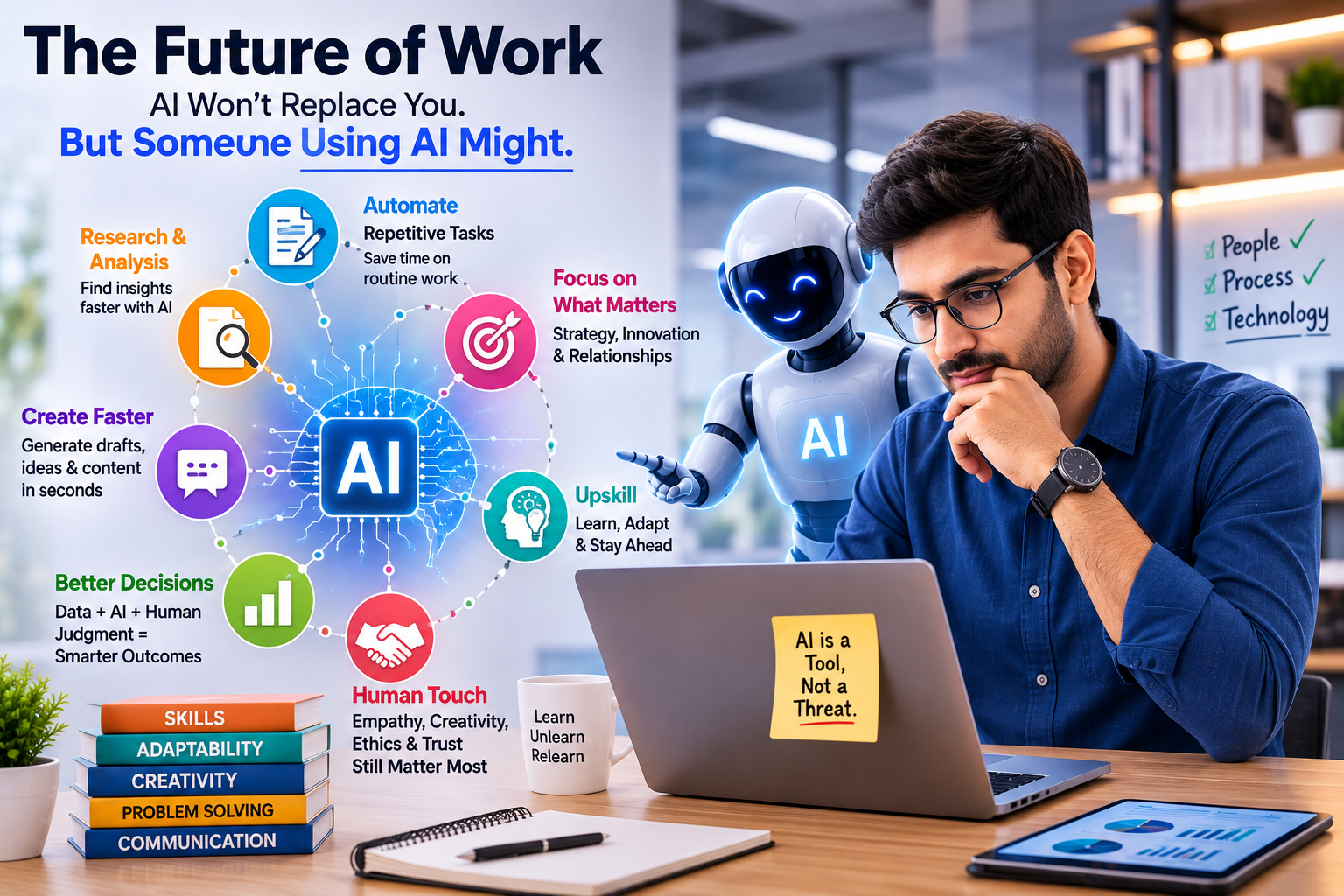
“Will AI take my job?”
It has become one of the most common questions about artificial intelligence.
Accountants ask it. Designers ask it. Developers ask it. Marketers, teachers, customer-support teams and office workers ask it too.
But there is a problem with the question.
A job is not one activity.
Almost every occupation is a collection of very different tasks. Some are repetitive. Some require judgment. Some involve communication. Others depend on physical work, responsibility, trust or knowledge of a specific situation.
That means a more useful question is:
Which parts of my job could AI change first?
Looking at tasks instead of job titles gives us a much clearer picture of how AI may reshape work.
Take One Job and Break It Apart
Consider a digital marketer.
Their job might include:
Collecting campaign data
Preparing reports
Writing first drafts
Researching competitors
Speaking with clients
Deciding budgets
Reviewing campaign performance
Understanding business goals
Handling unexpected problems
Approving final strategies
Calling all of this “digital marketing” hides an important difference.
AI may be very useful for summarizing campaign information.
But deciding why a business should increase its advertising budget involves context, financial priorities and responsibility.
The same job contains both highly automatable and highly human tasks.
Task 1: Repetitive Information Work
This is one of the clearest areas where AI can reduce manual effort.
Many employees spend time:
copying information, categorizing documents, preparing routine summaries, extracting data or converting information from one format into another.
AI systems can often assist with these activities because the objective is relatively clear.
For example, instead of manually reading 200 customer messages and sorting them by subject, an AI system could prepare categories for review.
The human may then focus on unusual or important cases.
This does not necessarily eliminate the role.
It changes where the employee spends their time.
Task 2: Creating the First Version
Another category likely to change significantly is first-draft work.
AI can already generate:
emails, outlines, meeting summaries, basic code, presentation structures, product descriptions and many other forms of initial content.
But a first version and a finished professional result are different things.
Suppose an HR professional needs to prepare an internal announcement.
AI may produce a reasonable draft in seconds.
The HR professional still needs to consider:
Is it accurate?
Does it reflect company policy?
Could employees misunderstand it?
Is anything confidential?
Does the tone fit the situation?
The task shifts from:
Create everything → Review, improve and take responsibility.
That is an important change in how knowledge work may operate.
Task 3: Searching Through Too Much Information
Many professionals are not short of information.
They have too much of it.
A manager may have years of emails.
A lawyer may have extensive documents.
A salesperson may have hundreds of CRM records.
A technician may have large manuals.
AI-assisted search and summarization can potentially make these information collections easier to navigate.
Instead of manually opening twenty documents, a user might ask a system to locate material related to a specific issue.
But there is still a reliability problem.
AI can miss information or summarize it incorrectly.
For important decisions, people still need the ability to return to the original source and verify what was actually written.
Task 4: Pattern Detection
AI can process large amounts of structured data faster than a person can manually inspect it.
This makes pattern detection another important category.
Examples include:
unusual financial transactions, changing customer behaviour, equipment performance, inventory patterns or website activity.
The value isn’t necessarily that AI makes the final decision.
Often, the value is:
“Something unusual is happening here. Look at this first.”
Humans can then investigate.
This combination can be powerful because machines are good at scanning enormous datasets while humans can bring context to the anomaly.
What Tasks Are Harder to Hand Over?
Now consider the other side.
Imagine a manager has to tell an employee that their performance is declining.
AI could potentially summarize performance data or help prepare talking points.
But conducting the actual conversation requires much more.
The manager must understand:
tone, history, workplace context, emotion, fairness and how the employee responds in real time.
Similarly, many jobs contain responsibilities involving negotiation, trust, leadership, empathy or accountability.
AI may support those activities without being an appropriate substitute for the responsible person.
Physical Work Is Another Different Category
AI discussions are often dominated by office jobs because generative AI operates naturally with text, images, code and digital information.
Physical work is different.
An electrician doesn’t merely “know electrical information.”
They operate in real environments.
They inspect physical conditions, use tools, move through unpredictable spaces and make safety-related judgments.
Automating physical work can require robotics, sensors, reliable perception and much more than a language model.
This doesn’t mean physical jobs will remain unchanged.
AI may assist with scheduling, diagnostics, documentation or training even when the core physical task remains human.
A Better Way to Evaluate Your Own Job
Instead of searching the internet for:
“Will AI replace my profession?”
Write down the major tasks you perform during a normal week.
Then place them into a simple map.
Type of Task Possible AI Impact
Repetitive digital work Higher automation potential
First drafts Strong AI assistance
Large-scale information search Strong AI assistance
Pattern detection Strong AI support
Complex judgment Human oversight important
Relationship building Strong human role
High-stakes decisions Human accountability critical
Unstructured physical work Harder to automate fully
This won’t predict the future perfectly.
But it gives you something much more useful than a list claiming that ten professions will “disappear.”
Your Job May Become Smaller in Some Areas and Bigger in Others
Suppose AI reduces the time required to prepare a weekly report from three hours to thirty minutes.
What happens to the remaining time?
The answer depends on the organization.
The employee might analyze results more deeply.
They might manage more clients.
They might take on different responsibilities.
Or the company might decide it needs fewer hours devoted to that function.
Technology can create productivity gains without guaranteeing how employers will distribute those gains.
This is why the impact of AI on employment is difficult to reduce to a simple “replacement versus no replacement” argument.
The Valuable Skill May Be Knowing What Not to Automate
As AI tools become easier to use, generating something may become less impressive.
Judgment becomes more important.
Workers may increasingly need to recognize:
When can AI save time?
When should I verify the result?
What information should never be entered into an unsuitable tool?
Which decision requires a responsible human?
When is an AI output confidently wrong?
Someone who automates everything without understanding risk may create more problems than someone who uses less AI intelligently.
AI Literacy Will Matter Beyond Technology Jobs
You don’t necessarily need to become an AI engineer.
A retailer can learn how AI affects inventory.
A farmer can understand AI-assisted crop monitoring.
A construction manager can understand computer-vision monitoring.
A clinic administrator can understand documentation automation.
An accountant can understand automated document processing.
In each case, the important skill is not merely knowing how to talk to a chatbot.
It is understanding where AI fits into the actual workflow of the industry.
Don’t Ask Whether Your Job Will Disappear
Nobody can reliably predict the exact shape of every occupation years into the future.
Technology changes.
Businesses adapt.
Regulation evolves.
Customers behave differently.
New responsibilities emerge.
Instead of trying to predict whether your entire profession will exist, examine the work inside it.
Ask:
Which tasks are repetitive?
Which involve large amounts of information?
Which can AI prepare but shouldn’t approve?
Which require my judgment?
Where am I personally accountable for the outcome?
Which skills would become more valuable if routine work became easier?
That produces a much more practical response to AI.
The future of work may not be a simple contest between humans and machines.
For many professions, it may be a continuous redesign of who—or what—handles each part of the workflow.
And the people best prepared for that future may not be those who can predict exactly what AI will do.
They may be the people who understand which tasks should be automated, which should be assisted and which should remain firmly human.
FAQs
Will AI replace most jobs?
It is difficult to predict employment outcomes that broadly. AI can automate or change individual tasks without necessarily eliminating the entire occupation.
Which tasks are easiest for AI to automate?
Structured, repetitive digital tasks involving information processing, classification, summarization or drafting are often strong candidates for AI assistance.
Which human skills may become more important?
Judgment, communication, accountability, domain expertise, leadership, problem-solving and the ability to verify AI-generated work can remain highly valuable.
Should I learn AI even if I don’t work in technology?
Understanding how AI affects workflows in your own profession can be useful even if you never build an AI system yourself.
What is the best way to prepare for AI changes at work?
Study your actual tasks rather than worrying only about your job title. Identify where AI can assist you, where verification is necessary and which parts of your work depend most heavily on human expertise and responsibility.