
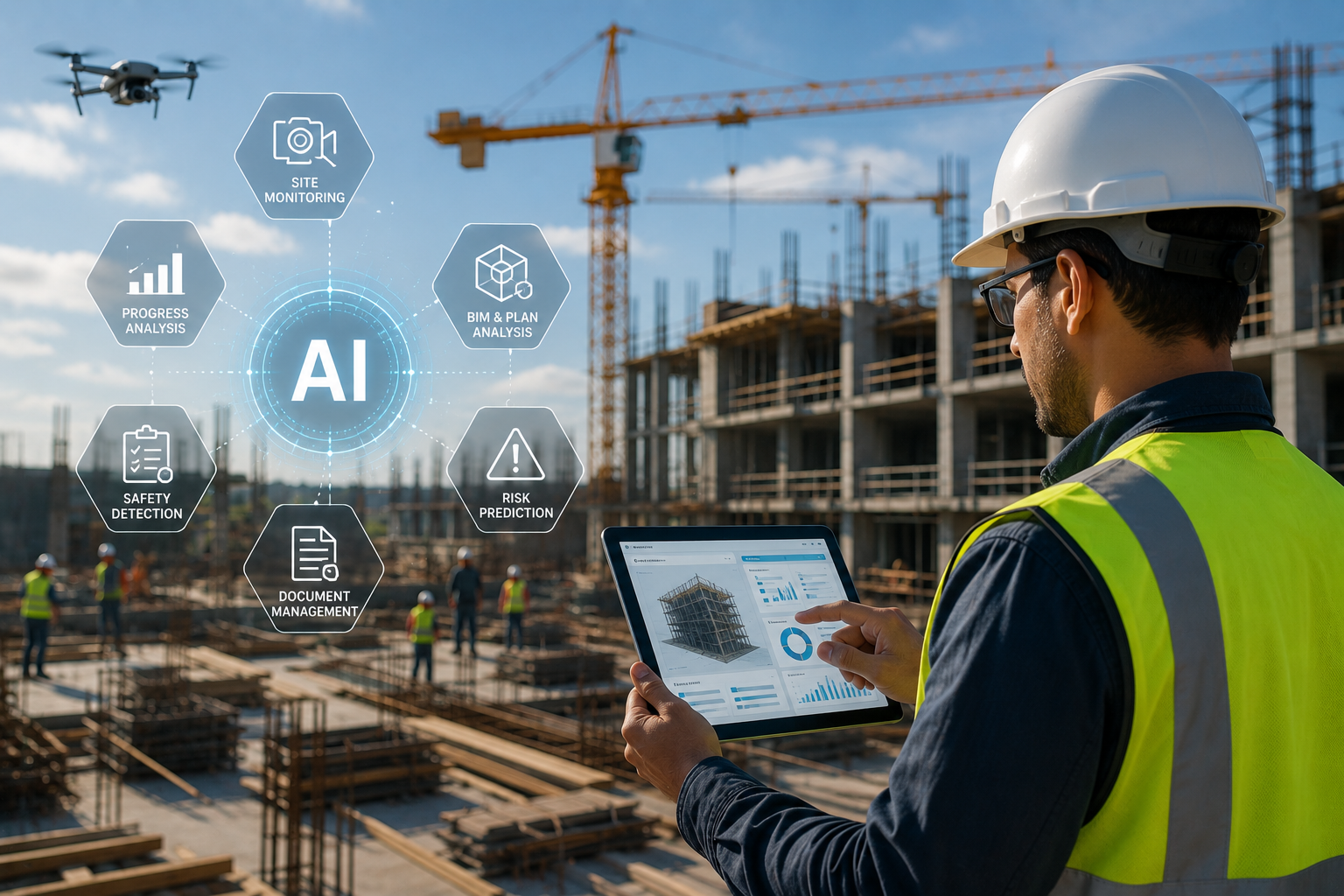
A construction mistake rarely becomes expensive at the exact moment it is made.
The real cost often appears later.
A measurement is missed. A drawing revision is overlooked. Materials arrive at the wrong time. Work progresses before someone notices that what has been built does not match the latest plan.
By the time the problem is discovered, fixing it may involve rework, wasted material, additional labour and schedule disruption.
This creates an interesting opportunity for artificial intelligence.
Instead of asking whether AI can “build a building,” a more useful question is:
Can AI help construction teams notice problems earlier?
That is where AI may become particularly valuable.
Construction Produces More Data Than It May Seem
A construction site is physical, but modern projects also generate a huge amount of digital information.
There may be:
Architectural drawings
Engineering documents
BIM models
Site photographs
Inspection records
Progress reports
Material schedules
Equipment information
Safety documentation
Emails and change requests
Cost and procurement records
The challenge is not simply collecting information.
The challenge is connecting what was planned with what is actually happening on site.
AI can potentially help teams examine some of this information faster and identify areas that deserve human attention.
Can AI Compare the Plan With Reality?
Imagine that a project has a digital model showing what should have been completed by this week.
The site also has recent photographs, video or other progress information.
Computer-vision systems can potentially help analyze visual information and compare observable progress with project records.
Instead of a manager manually checking hundreds of images, software could help identify areas where progress appears inconsistent or requires review.
The system isn’t necessarily declaring:
“This construction is wrong.”
A safer role is:
“This area appears different from the expected condition. Please inspect it.”
That distinction matters.
AI can help prioritize attention without pretending to replace qualified engineers or site professionals.
A Small Error Can Travel Through an Entire Project
Consider a simple example.
An opening is positioned incorrectly.
Initially, it may look like a minor issue.
But later:
the door may not fit correctly → electrical work may need adjustment → finishing may be affected → another contractor may need to return → the schedule changes.
Construction tasks are interconnected.
That means early detection can sometimes be more valuable than faster correction.
AI-assisted monitoring could potentially highlight unusual conditions earlier, allowing the responsible professional to investigate before additional work builds on top of the original problem.
Drawings Are Another Area Where AI Could Help
Large projects can involve many documents and revisions.
The challenge is ensuring that people are working from the appropriate information.
AI-based document systems could help users:
search technical documents, compare versions, locate relevant information or identify differences that deserve attention.
For example, rather than manually opening several documents to find where a particular specification changed, an AI-assisted system might help surface the relevant sections.
But this comes with an important warning.
Technical drawings and specifications affect real structures.
An AI-generated summary should not automatically become an engineering instruction.
The original approved documents and responsible professionals remain essential.
What About Material Estimation?
Estimating construction quantities can involve significant repetitive work.
Depending on the project and available digital information, software can assist with tasks such as identifying components, organizing quantities or supporting cost-estimation workflows.
AI may make some of these processes faster.
But an automatically generated quantity should still be treated carefully.
A small error multiplied across a large project can become a large purchasing error.
For this reason, AI works best when it helps professionals prepare calculations for verification, rather than turning uncertain outputs directly into purchase orders.
AI Could Help Answer a Surprisingly Difficult Question
Ask a project manager:
“Why are we behind schedule?”
There may not be one answer.
Perhaps a material arrived late.
Then one crew couldn’t start.
That delayed another activity.
An inspection moved.
Equipment remained unused.
A later task was pushed into the following week.
Project-management systems contain pieces of this story, but understanding the relationship between events can require considerable analysis.
AI could potentially help examine schedules, reports and project records to identify patterns associated with delays.
This could help managers investigate:
Where did the delay begin?
Which activities are affected?
What needs attention now?
The final decision still belongs to the project team.
Safety Is Promising — and Sensitive
Computer vision is also being explored for construction-site safety.
Depending on the system and environment, visual technologies may help identify certain predefined conditions, such as whether required protective equipment appears to be present in monitored areas.
But safety is too important to outsource blindly to software.
A camera may have a poor angle.
An object may be hidden.
A model may incorrectly classify what it sees.
Site conditions may involve risks the system was never designed to detect.
AI can therefore be an additional observation layer, not a substitute for proper safety procedures, trained personnel and regulatory compliance.
Predictive Maintenance Could Reduce Equipment Surprises
Construction depends heavily on machinery and equipment.
Traditional maintenance can sometimes be based on schedules:
Inspect after X hours. Service after Y period.
When suitable sensors and equipment data are available, predictive systems may analyze patterns such as vibration, temperature or operating behaviour.
The objective is to identify unusual changes that could indicate a developing problem.
Instead of waiting for equipment to fail unexpectedly, teams may receive an earlier indication that inspection is needed.
Again, AI isn’t repairing the machine.
It is helping humans decide where to look sooner.
The Construction Manager May Get a New Kind of Dashboard
Today’s dashboard might show:
Project completion: 63%
A more intelligent future dashboard could potentially say:
Progress appears normal overall, but three areas require attention.
One activity appears behind schedule.
Material usage differs from the planned quantity.
Recent site imagery indicates an area that may require inspection.
That is much more useful than simply displaying more data.
The future of construction software may be about converting enormous amounts of project information into prioritized attention.
Where AI Should Not Make the Final Call
There is an important boundary.
Construction involves:
structural safety, building codes, contracts, worker safety, engineering responsibility and substantial financial risk.
AI should not be treated as an unquestionable authority in these areas.
An AI system can misunderstand drawings.
It can miss context.
Its training data may not reflect local requirements.
It can produce a confident answer that is still incorrect.
Qualified architects, engineers, safety professionals, contractors and inspectors remain responsible for decisions within their professional roles.
Small Contractors Could Benefit Too
AI in construction isn’t necessarily limited to massive infrastructure projects.
Smaller contractors may eventually benefit from simpler applications such as:
organizing site photographs, summarizing daily reports, finding information in project documents, preparing administrative updates, tracking materials or organizing customer communication.
The technology doesn’t need to predict the structural future of a skyscraper to be useful.
Saving someone from manually searching through 200 site photographs can already have practical value.
The Future Construction Site May Look Surprisingly Normal
There may still be workers, cranes, concrete, steel, dust, drawings and site meetings.
AI doesn’t need to turn the construction site into a science-fiction movie.
Its biggest contribution may happen quietly behind the scenes.
It can help teams:
see changes earlier, find information faster, organize project data and focus human attention where it matters most.
The objective isn’t:
AI builds the project.
A much more realistic objective is:
AI helps the people building the project discover costly problems before those problems become even more expensive.
And in an industry where a small mistake can affect many later stages, that early warning could be extremely valuable.
FAQs
Can AI detect construction defects?
AI and computer-vision systems can help identify certain visual patterns or anomalies, depending on their design and the quality of available data. Findings should still be reviewed by qualified professionals.
Can AI read construction drawings?
Some AI-enabled tools can assist with searching, extracting or analyzing information from project documents, but important technical decisions should be verified against approved documents.
Will AI replace construction managers?
AI is more likely to assist with information analysis, monitoring and administration than completely replace the judgment and coordination required from experienced construction professionals.
Can small construction companies use AI?
Yes. Smaller businesses may benefit from practical applications such as document organization, reporting assistance, photo management and administrative automation without needing complex AI infrastructure.
Is AI reliable enough for construction safety decisions?
AI may support certain monitoring tasks, but it should not replace established safety procedures, qualified personnel, inspections or applicable regulatory requirements.