
Walk into a supermarket on a busy weekend and you may notice something frustrating.
The product you came for is unavailable.
For the customer, it is an empty shelf.
For the retailer, however, that empty space may represent a much larger problem involving inventory forecasting, supplier timing, warehouse availability, local demand and replenishment decisions.
Retail has always tried to answer a difficult question:
What will customers want next—and how much should we keep ready?
Artificial intelligence is giving retailers new ways to approach that question.
And unlike futuristic cashier-free stores or humanoid robots, some of the most valuable AI in retail may be almost invisible to customers.
The Real Retail Problem Is Not Simply “More Stock”
Keeping every product in large quantities sounds like an easy solution.
It isn’t.
Too little inventory can mean:
empty shelves → missed sales → disappointed customers.
Too much inventory creates a different chain:
excess stock → storage costs → markdowns → waste or tied-up capital.
The ideal situation is somewhere between the two.
Retailers need enough inventory to satisfy demand without unnecessarily overstocking.
Traditional forecasting can use previous sales and predefined rules. AI-based forecasting can potentially analyze broader patterns and relationships across larger datasets.
The objective is not to magically predict every purchase.
It is to make better-informed inventory decisions.
Yesterday’s Sales Don’t Always Predict Tomorrow
Imagine a store normally sells 20 units of a particular product each day.
Ordering another 20 for tomorrow might appear reasonable.
But tomorrow isn’t necessarily a normal day.
Demand could be affected by:
Weekends
Festivals
Local events
Weather
Promotions
Seasonal changes
Price changes
Online campaigns
Product availability
Recent buying patterns
An AI forecasting system can potentially examine combinations of relevant historical and current data rather than relying only on a simple average.
For example, it might identify that a particular product tends to sell faster on certain days or during particular seasonal conditions.
That information can help inventory teams prepare earlier.
One Retail Chain Can Contain Hundreds of Different Markets
Suppose a retailer operates 100 stores.
Should every location receive exactly the same inventory?
Probably not.
A product popular in one neighbourhood may move slowly somewhere else.
Even stores in the same city can have different customer behaviour.
AI can potentially help retailers forecast at a more local level.
Instead of asking:
“How many units will our company sell?”
the system can help investigate:
“How many units might this particular location need?”
That creates opportunities for more precise replenishment.
AI Could Notice the Shelf Before the Customer Does
Inventory databases tell retailers what their systems believe is available.
The physical shelf can tell a different story.
Perhaps stock exists in the building but hasn’t been placed on the shelf.
Maybe an item was moved.
Perhaps inventory records are inaccurate.
Computer vision is one technology being explored for monitoring physical retail environments.
With appropriate cameras and systems, software can potentially recognize certain shelf conditions and alert staff when a product appears low or unavailable.
The goal isn’t necessarily to remove store employees.
It is to prevent employees from having to continuously inspect every shelf manually.
AI can say:
“This area may need attention.”
A staff member can then investigate what actually happened.
The Warehouse Has the Same Challenge on a Bigger Scale
The intelligence behind a store doesn’t begin at the shelf.
Products move through a much larger chain:
Supplier → Distribution Centre → Transport → Store → Shelf → Customer
A problem anywhere in that chain can affect availability.
AI-assisted supply planning could potentially combine information about demand, inventory, deliveries and supplier performance to help teams identify possible shortages earlier.
For example, if demand for a product is rising while incoming supply is delayed, the system could flag the situation.
A human planner can then decide whether to:
redistribute inventory, adjust an order, contact a supplier or take another appropriate action.
This is a recurring theme with useful AI:
detect earlier, decide better.
AI Can Also Change Product Discovery
Inventory isn’t the only part of retail being affected.
Consider an online customer searching:
“Comfortable black shoes for standing all day under ₹3,000.”
Traditional search often relies heavily on matching keywords.
AI-powered product discovery can potentially interpret more of the customer’s intent:
Colour: black
Use: long periods of standing
Budget: under ₹3,000
Product: shoes
Priority: comfort
That can make product search more conversational and contextual.
Instead of forcing customers to understand a store’s category structure, the store can become better at understanding what the customer is trying to find.
Customer Service Can Become More Useful Too
Retail customer-service teams repeatedly handle questions such as:
“Where is my order?”
“Can I return this?”
“Is this available in another size?”
“When will this product be back?”
AI assistants connected to appropriate business systems may help answer routine questions faster.
However, the quality of the answer depends on the quality of the underlying information.
An AI system cannot reliably tell a customer when something will arrive if it doesn’t have trustworthy delivery data.
This is why connecting AI to accurate business information is often more important than making the chatbot sound human.
What About AI Changing Prices?
AI can also support pricing analysis, but this is a more sensitive area.
Retailers have long changed prices because of promotions, inventory, competition, seasons and other business factors.
AI can make analysis faster and more granular.
But automated pricing requires careful governance.
Companies need to consider:
Consumer trust
Applicable laws
Pricing accuracy
Fairness
Brand strategy
Unexpected algorithmic behaviour
Just because software can change a price doesn’t mean it should have unlimited authority to do so.
High-impact decisions need appropriate oversight.
Fraud Detection Is Another Invisible AI Application
Retail businesses process enormous numbers of transactions.
Most are legitimate.
A small percentage may contain unusual behaviour.
AI-based systems can help identify patterns that deserve investigation—for example, unusual transaction or account activity.
Importantly, an unusual pattern is not automatically proof of fraud.
A useful system helps prioritize cases for appropriate review rather than assuming every anomaly represents wrongdoing.
This is another example where AI is strongest as an attention-management tool.
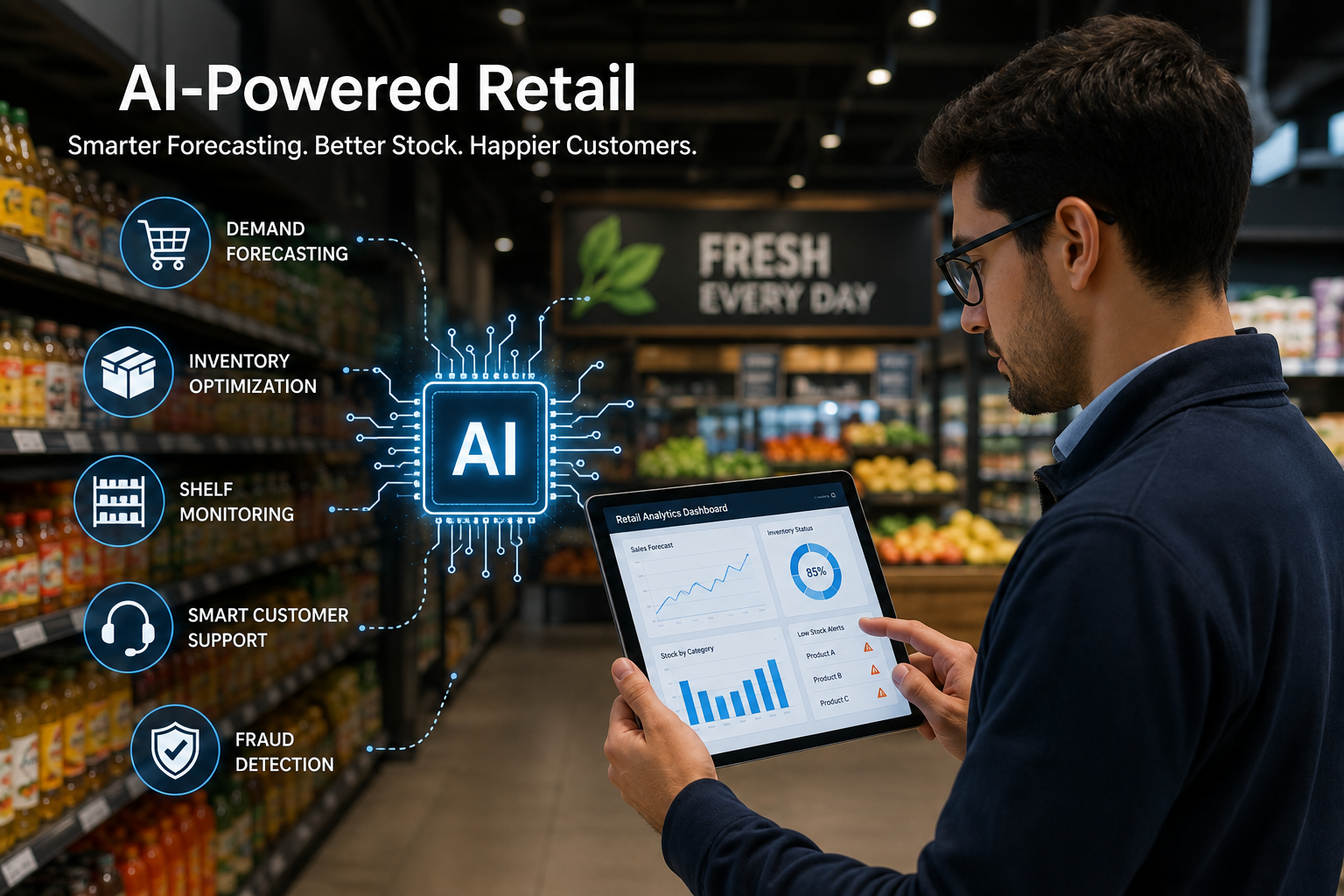
The Store Manager’s Dashboard Could Change Completely
A traditional retail dashboard may tell a manager:
Yesterday’s sales: ₹X
Useful—but historical.
A more intelligent system could potentially highlight:
These products may run low soon.
This category is selling differently from its normal pattern.
Stock exists in storage but shelf availability appears low.
One location has excess inventory while another may need more.
Now the dashboard isn’t merely reporting what happened.
It is helping people decide what deserves attention next.
AI Still Has a Serious Weakness: Bad Data
AI forecasting can look sophisticated and still fail when its underlying information is poor.
If inventory counts are wrong, product records are inconsistent or historical data contains unusual disruptions, predictions can become unreliable.
There are also events that historical patterns cannot easily anticipate.
A viral social-media post could suddenly increase demand.
Unexpected weather could change customer behaviour.
A competitor could close nearby.
A supplier could experience disruption.
AI forecasts should therefore be treated as decision support, not guaranteed predictions.
The Future Store May Not Look Futuristic
The most interesting part of AI-powered retail is that customers may barely notice it.
There may be no robots walking through every aisle.
Instead, the store simply seems better organized.
Products are available more often.
Employees discover shelf problems earlier.
Warehouses send inventory where it is needed.
Online search understands customers more naturally.
Support teams resolve routine questions faster.
Behind those improvements could be AI continuously helping retailers answer three questions:
What is happening?
What might need attention next?
Where should humans act?
The store of the future may therefore not be defined by how much AI customers can see.
It may be defined by how effectively technology helps ensure that the product a customer wants is in the right place at the right time.
FAQs
Can AI predict exactly what customers will buy?
No. AI can identify patterns and generate forecasts from available data, but customer behaviour and external events remain uncertain.
How can AI reduce empty shelves?
AI can support demand forecasting, inventory monitoring, replenishment planning and, in some environments, computer-vision-based shelf monitoring.
Can small retailers benefit from retail AI?
Potentially, yes. Cloud-based inventory, analytics, customer-service and e-commerce tools increasingly include AI capabilities without requiring retailers to build their own AI systems.
Will AI replace retail employees?
Some repetitive tasks may become automated, but stores still require people for customer interaction, physical operations, exceptions, judgment and management.
What is the biggest limitation of AI in retail?
Data quality is one major limitation. Predictions based on inaccurate inventory, incomplete sales information or unusual historical conditions can lead to poor decisions.