
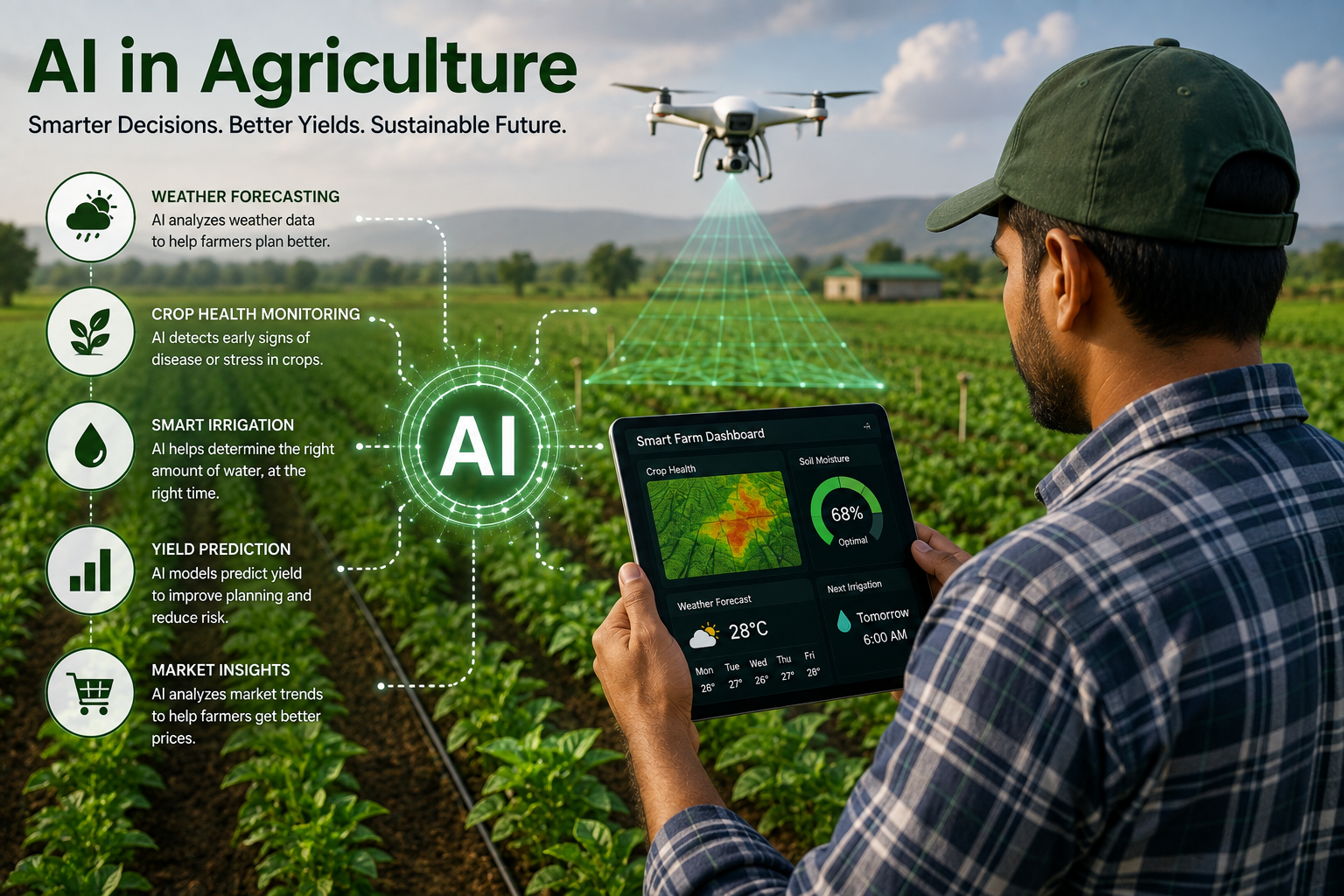
When people imagine artificial intelligence in agriculture, they often picture a futuristic farm filled with autonomous tractors, drones and robots harvesting crops.
That future may develop in some places.
But AI does not need to physically replace farm workers to make agriculture smarter.
Some of its most practical uses may happen on an ordinary smartphone—helping farmers and agricultural businesses interpret weather, soil, crop, irrigation and market information before making decisions.
The bigger opportunity is not necessarily:
“Can AI farm without humans?”
It is:
“Can AI help farmers make better decisions with the information already available?”
Farming Is a Continuous Series of Decisions
Growing a crop isn’t one decision.
It involves hundreds.
When should planting begin?
Does the field need irrigation?
Is the crop showing signs of disease?
Will the weather affect tomorrow’s work?
How much fertilizer may be appropriate?
Which part of a field needs attention?
When should harvesting begin?
Where should produce be sold?
Farmers have always made these decisions using experience, observation and local knowledge.
Technology can add another layer: data-assisted decision-making.
AI becomes useful when it can convert complicated information into something actionable.
The First Opportunity Is Something Every Farmer Already Watches: Weather
Weather has always shaped agriculture.
But knowing that “rain is possible tomorrow” may not be enough.
A farmer may need to understand how expected conditions relate to a specific activity.
For example:
Is irrigation necessary today if rain is expected?
Could strong wind interfere with a planned activity?
Are conditions becoming favourable for a particular crop problem?
AI-assisted agricultural systems can potentially combine forecasts with crop, field and historical information to produce more relevant decision support.
However, weather forecasts remain forecasts.
AI cannot guarantee that rain will occur exactly when or where predicted.
The purpose is to help manage uncertainty—not eliminate it.
AI Can Help Farmers See What the Eye Might Miss
A field can look uniformly green from the road while individual areas are experiencing very different conditions.
Satellite imagery, drones and other remote-sensing technologies can collect visual information across agricultural land.
Computer-vision and AI systems may help analyze those images to identify unusual patterns.
Perhaps one area shows different vegetation characteristics.
Perhaps another appears stressed.
Instead of treating the entire field as one unit, the farmer can investigate specific areas.
This changes the workflow from:
“Inspect everything equally.”
to:
“These areas may deserve attention first.”
That can be especially useful across larger farms.
Could a Phone Camera Help Identify a Crop Problem?
This is one of the most accessible possibilities.
A farmer notices unusual marks on a leaf.
Instead of waiting until the issue spreads, they photograph it.
Computer-vision applications can potentially compare visible characteristics with patterns learned from relevant datasets and suggest possible categories or causes for further investigation.
But this needs an important warning.
A photograph does not always contain enough information for a reliable diagnosis.
Different diseases, nutrient deficiencies, pests or environmental stress can sometimes produce similar visible symptoms.
Lighting and image quality can also affect analysis.
Therefore, AI identification should often be treated as an early screening tool, not unquestionable agricultural advice.
When the issue is significant or uncertain, appropriate agricultural experts remain important.
Smarter Irrigation Could Be More Valuable Than a Farming Robot
Water management is another area where data can have direct practical value.
Traditional irrigation decisions may rely on schedules or visual observation.
More advanced systems can incorporate information such as:
Soil moisture
Recent rainfall
Weather forecasts
Crop stage
Temperature
Field conditions
AI can potentially analyze these signals and help determine where water may be needed.
The objective isn’t simply to use less water.
It is to apply water more appropriately according to actual conditions.
A field may not need identical irrigation everywhere.
That is where precision agriculture becomes particularly interesting.
AI Could Help Create a Different Map of the Farm
A normal map tells you where a field is.
A data-driven farm map could potentially show:
Area A: normal conditions
Area B: possible moisture stress
Area C: unusual vegetation pattern
Area D: requires inspection
This creates a different way of managing agricultural land.
Instead of thinking only in acres or hectares, farmers can increasingly think in zones with different needs.
The technology does not replace someone walking through the field.
It can help determine where they should walk first.
The Opportunity Continues After Harvest
Agriculture doesn’t end when a crop leaves the field.
Produce still needs to move through:
sorting → storage → transport → wholesale → retail → consumer
Problems during these stages can reduce quality and increase waste.
AI-based systems may support tasks such as visual quality classification, storage monitoring, logistics planning or demand forecasting.
For perishable products, timing is particularly important.
If supply-chain participants have better information about demand, inventory and product condition, they may be able to make better distribution decisions.
Can AI Help Farmers Understand Markets?
Farmers may face another difficult question:
Where and when should I sell?
Market information can be fragmented.
Prices can vary by location, quality, timing and market conditions.
AI systems could potentially organize large amounts of available market information and make trends easier to understand.
For example, a system might summarize recent movements across relevant markets rather than requiring someone to manually review many individual sources.
But predicting agricultural prices is difficult.
Weather, demand, international markets, policy changes, transportation and many other factors can affect prices.
An AI forecast should never be treated as a guaranteed future selling price.
Small Farmers Don’t Need Their Own AI Laboratory
One misconception is that agricultural AI requires every farmer to buy expensive machines.
In reality, many capabilities can potentially be delivered through:
smartphone applications, shared agricultural services, cooperatives, advisory platforms or cloud-based systems.
A farmer doesn’t need to understand machine-learning algorithms to benefit from useful analysis.
They need an interface that answers practical questions clearly.
For example:
“Which area of my field should I inspect today?”
That is much more valuable than displaying a complicated AI model.
Local Data Is the Difference Between Impressive AI and Useful AI
Agriculture varies enormously.
A recommendation suitable for one crop, soil type or climate may be inappropriate somewhere else.
Language matters.
Local farming practices matter.
Water availability matters.
Crop varieties matter.
Regional pests and diseases matter.
This means agricultural AI needs relevant local data and context.
A globally trained system that knows a lot about farming in general may still perform poorly when asked to understand a highly specific local situation.
AI in agriculture will become more useful when technology learns to work with local expertise rather than trying to replace it.
What AI Cannot Control
Even an excellent AI system cannot control:
unexpected weather, natural disasters, sudden pest outbreaks, market shocks, equipment failures or many other realities of agriculture.
It can also make mistakes.
Sensors can fail.
Images can be unclear.
Data can be incomplete.
Forecasts can change.
Therefore, farmers should not be encouraged to hand every important agricultural decision to an algorithm.
AI works best as another source of evidence and early warning alongside experience, observation and appropriate professional advice.
The Smart Farm May Still Look Like a Normal Farm
The future of agricultural AI may be less dramatic than science-fiction imagery suggests.
A farmer may still walk through the field.
Workers may still harvest crops.
Tractors may still be driven by people.
But behind those familiar activities, technology could be continuously helping answer:
Where is something changing?
Which area needs attention?
What information should I check before deciding?
Can resources be used more precisely?
That is why AI could transform farming without putting a robot on every field.
Its greatest value may not come from replacing the farmer.
It may come from giving the farmer a clearer picture of what is happening before the problem becomes obvious.
FAQs
Can AI detect crop diseases?
AI-based image analysis can help identify visual patterns associated with certain crop problems, but results can be uncertain and should not automatically replace expert diagnosis.
Can AI predict the weather for farmers?
AI contributes to modern forecasting and can help interpret weather information, but forecasts always contain uncertainty and cannot guarantee exact future conditions.
Is agricultural AI only useful for large farms?
No. Some AI-enabled services can be delivered through smartphones and shared platforms, making certain applications potentially useful for smaller farms as well.
Can AI help reduce water use?
AI-assisted irrigation systems can combine information such as soil moisture and weather conditions to support more precise watering decisions where suitable technology and data are available.
Will AI replace farmers?
AI may automate or assist specific agricultural tasks, but farming involves physical work, local knowledge, judgment and responses to unpredictable real-world conditions. AI is better viewed as a decision-support tool than a complete replacement for farmers.