
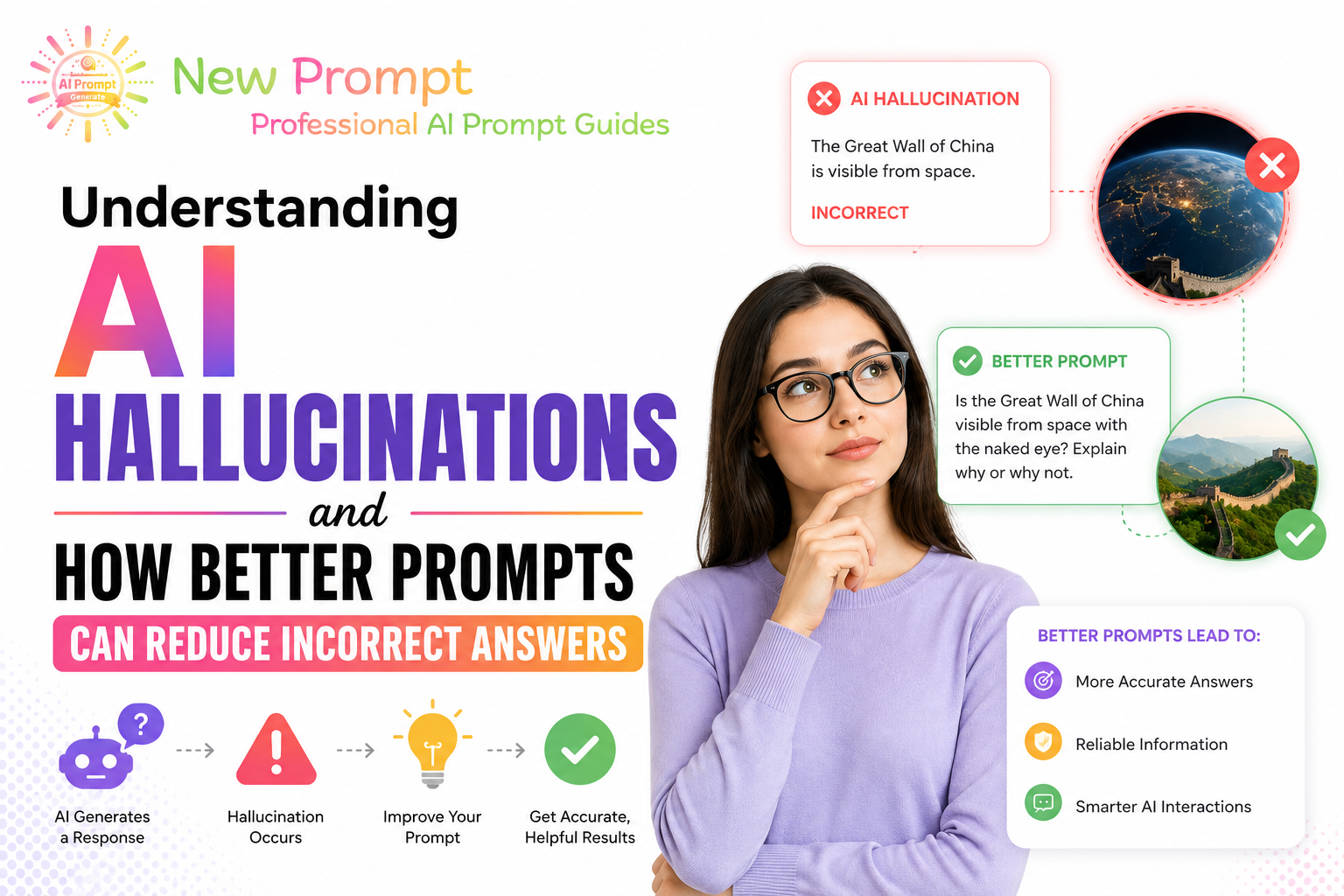
AI hallucinations — when models generate plausible but incorrect or fabricated information — are one of the most common challenges users face. This guide explains why hallucinations occur and how better prompt engineering can significantly reduce them.
What Are AI Hallucinations?
AI hallucinations occur when a language model generates information that sounds confident and reasonable but is factually incorrect, invented, or inconsistent with reality. This is not intentional deception but a limitation of how these models function.
Why Hallucinations Happen
- The model predicts the most statistically likely next words rather than retrieving verified facts
- Gaps in training data can lead to confident but wrong answers
- Ambiguous or poorly structured prompts increase the likelihood of hallucinations
How Better Prompts Reduce Hallucinations
1. Provide Clear Constraints
Technique: Explicitly limit the scope and sources.
Example: “Base your answer only on well-established scientific consensus from 2020–2026. If you are unsure, state ‘I don’t have sufficient verified information’ instead of speculating.”
2. Use Role Assignment with Expertise
Assigning a careful, evidence-based persona encourages more cautious responses.
3. Request Step-by-Step Reasoning
Chain of Thought prompting helps the model show its logic and reduces unsupported claims.
4. Ask for Sources or Evidence
Requesting supporting evidence often leads to more careful responses.
Advanced Techniques to Minimize Hallucinations
- Fact-Checking Prompts: Ask the AI to verify information before concluding
- Uncertainty Signaling: Instruct the model to clearly indicate confidence levels
- Multi-Step Verification: Break complex queries into smaller, verifiable parts
- Negative Constraints: Explicitly tell the model what not to do
Practical Example
Problematic Prompt: “What are the latest breakthroughs in quantum computing?”
Improved Prompt: “Act as a conservative technology researcher. Summarize only well-documented breakthroughs in quantum computing from peer-reviewed sources between 2023 and 2026. For each breakthrough, indicate the level of scientific consensus and practical readiness. If information is uncertain, clearly state so.”
Best Practices for Everyday Users
- Always verify critical information from reliable external sources
- Use more specific and constrained prompts for factual queries
- Combine multiple techniques rather than relying on one method
- Treat AI as a helpful assistant rather than an infallible expert
Conclusion
While AI hallucinations cannot be completely eliminated, better prompt engineering can significantly reduce their frequency and severity. By understanding why they occur and applying the techniques in this guide, you can use AI tools more safely and effectively.
Responsible AI usage involves good prompt design combined with critical thinking and external verification of important facts.
This guide contains approximately 950 words and explains AI hallucinations while providing practical prompt strategies to reduce incorrect answers.