
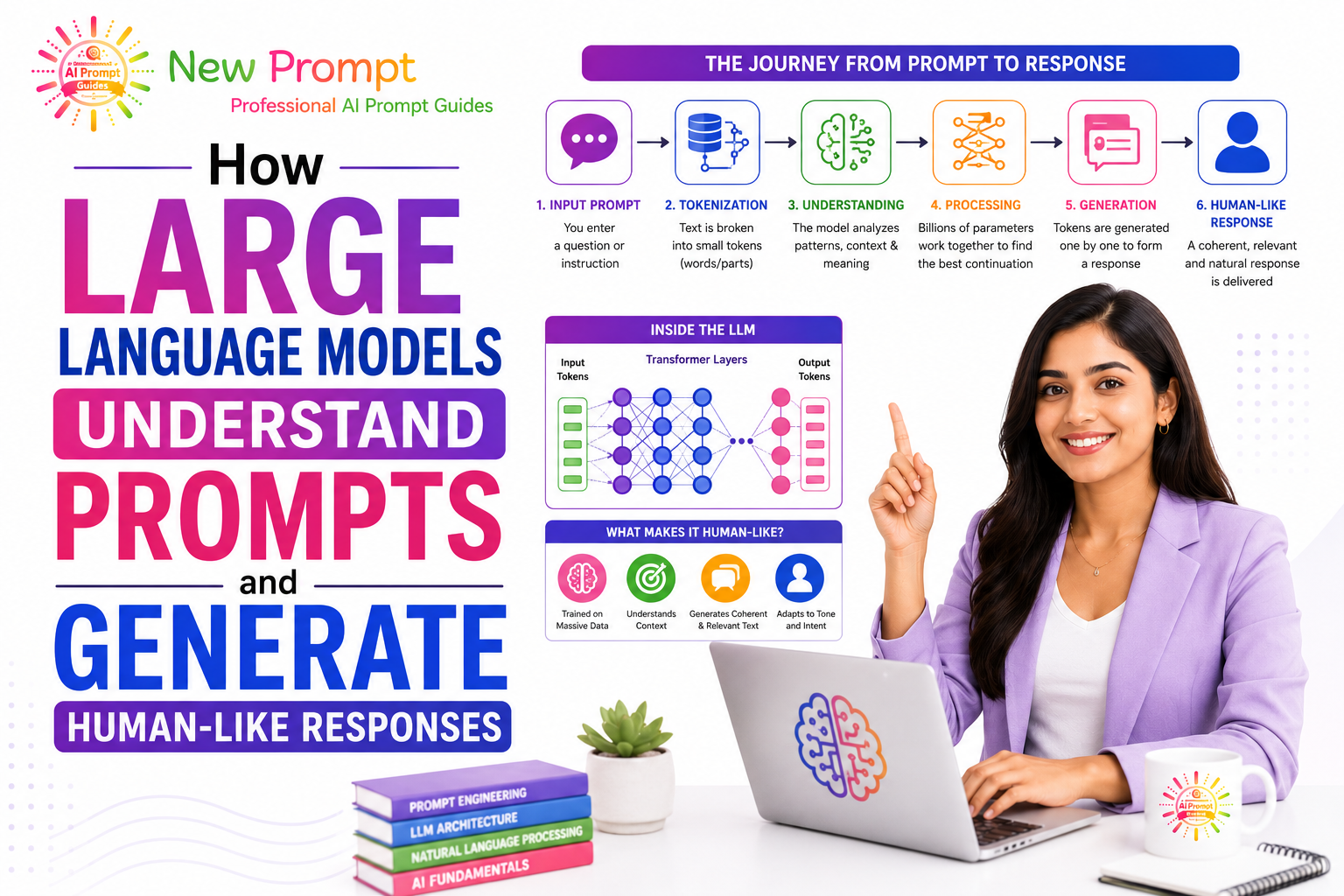
Large Language Models (LLMs) like ChatGPT, Claude, Grok, and Gemini have amazed users with their ability to understand prompts and generate remarkably human-like responses. This guide explains the fascinating process behind how these models work.
How Large Language Models Process Language
LLMs are trained on enormous datasets containing text from books, websites, articles, and conversations. They learn statistical patterns and relationships between words, phrases, and concepts rather than possessing true understanding like humans.
The Prompt Processing Pipeline
1. Tokenization
When you submit a prompt, the model first breaks it down into tokens — small units of text (words or subwords). This allows efficient processing of language.
2. Attention Mechanism
The model uses sophisticated attention mechanisms to analyze relationships between all tokens in the prompt. This helps it understand context and connections within your input.
3. Pattern Activation
Based on its training, the model activates relevant patterns and knowledge. Role assignments such as “Act as a professor…” help guide which patterns are most relevant.
4. Response Generation
The model generates output one token at a time, predicting the most likely next token while maintaining coherence with the entire conversation and prompt.
What Makes Responses Feel Human-Like?
LLMs simulate human-like responses by recombining patterns learned during training. They can adopt different styles, tones, and expertise levels because they have seen countless examples of such communication.
Factors That Influence Response Quality
- Prompt Clarity: Clear instructions lead to more accurate responses.
- Context Quality: Rich, relevant context improves relevance.
- Role Assignment: Specific personas guide the model’s behavior.
- Reasoning Guidance: “Think step by step” often produces better logical outputs.
Limitations of Large Language Models
Despite their capabilities, LLMs do not possess consciousness, genuine understanding, or real-time knowledge. They can generate plausible but incorrect information (hallucinations) and their knowledge is limited to their training cutoff date.
Practical Implications for Users
Understanding how LLMs work helps you write better prompts. The more precisely you communicate your intent, the better the model can align its pattern-matching capabilities with your needs.
Conclusion
Large Language Models transform simple text prompts into coherent, useful, and often creative responses through sophisticated pattern recognition and statistical prediction. By learning how these systems process language, you become a more effective collaborator with AI.
This knowledge empowers you to craft better prompts, set realistic expectations, and maximize the value you receive from generative AI tools.
This guide contains approximately 920 words and explains the inner workings of large language models and how they generate human-like responses.