
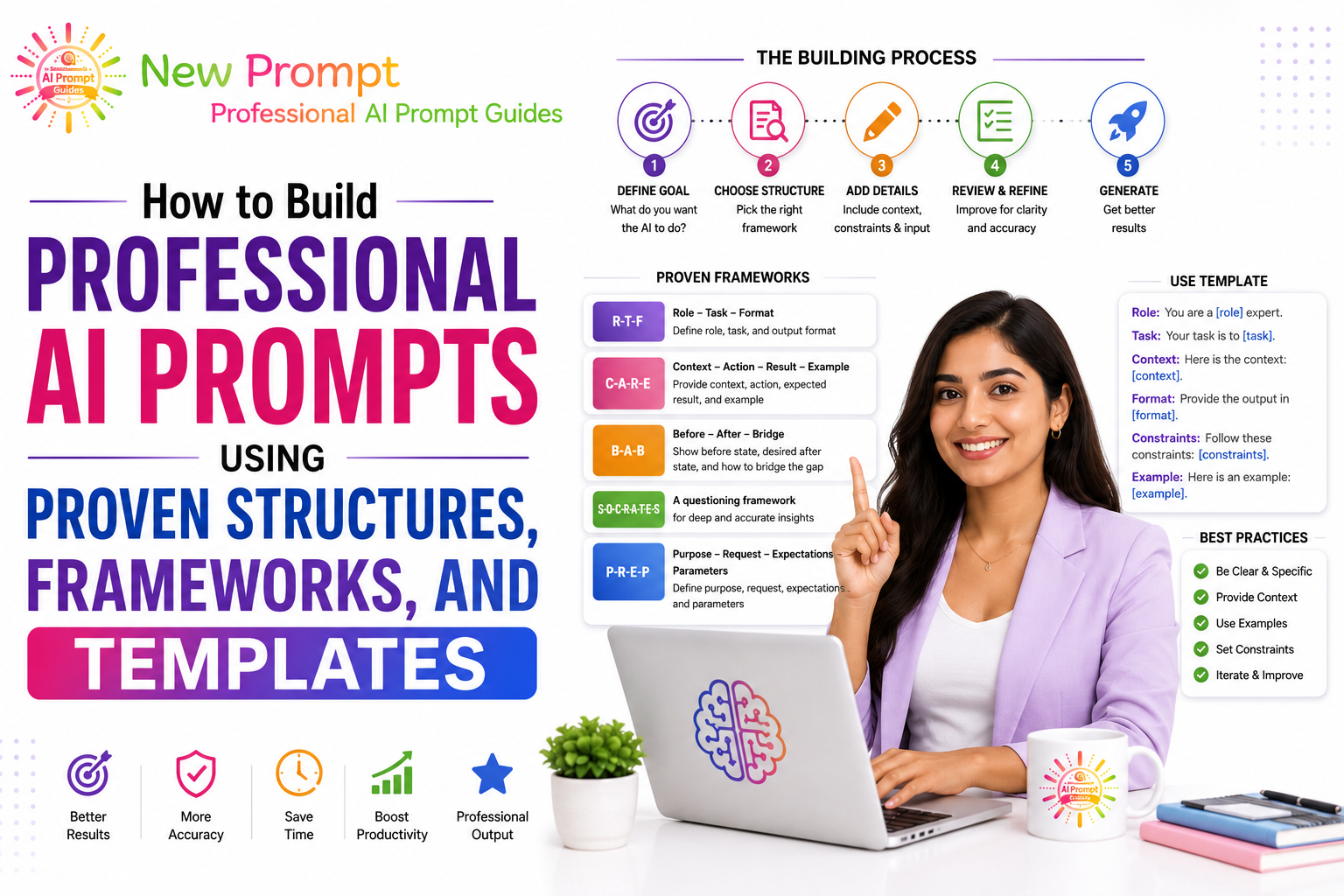
Professional AI prompts are built using proven structures, frameworks, and reusable templates. This guide teaches you how to create consistently high-quality prompts using established methods used by expert prompt engineers.
Why Structure and Frameworks Matter
Well-structured prompts reduce ambiguity, improve consistency, and help AI models understand your intent more accurately. Frameworks provide reliable scaffolding for different types of tasks.
Proven Prompt Frameworks
1. The COSTAR Framework
Context – Background information
Objective – Clear goal
Style – Tone and approach
Task – Specific request
Audience – Target reader
Response Format – Desired output structure
2. The RISE Framework
Role – Assign expertise
Instruction – Main task
Specifications – Format, length, constraints
Examples – Few-shot examples when needed
Professional Prompt Templates
General Purpose Template
“Act as a [ROLE] with [EXPERTISE] experience.
Objective: [CLEAR GOAL]
Context: [BACKGROUND]
Task: [SPECIFIC REQUEST]
Requirements: [DETAILS]
Output Format: [STRUCTURE]
Constraints: [LIMITATIONS]”
Content Creation Template
“Act as a professional [content type] writer.
Write a [length] [format] on [topic] for [audience].
Tone: [tone].
Include [key elements].
Structure with clear headings and engaging language.”
Analysis Template
“Act as an expert [field] analyst.
Analyze [subject] and deliver:
1. Key findings
2. Strengths and weaknesses
3. Actionable recommendations
Think step by step and support conclusions with clear reasoning.”
Image Generation Prompt Structure
“[Main subject], [detailed description], [environment], [lighting and mood], [style references], [technical quality parameters], highly detailed, sharp focus, 8k resolution, masterpiece, best quality.”
Best Practices for Using Frameworks and Templates
- Customize templates with specific details for each task
- Combine multiple frameworks when needed
- Test and refine templates regularly
- Maintain a well-organized personal library
- Document successful variations
Advanced Techniques
- Use Chain of Thought within frameworks
- Add Few-Shot examples for complex tasks
- Create meta-prompts to improve other prompts
- Develop industry-specific framework variations
Conclusion
Building professional AI prompts using proven structures, frameworks, and templates is one of the most effective ways to achieve consistent, high-quality results. The investment in learning these methods will significantly enhance your productivity and creative capabilities with AI.
Start by selecting one framework and a few templates that match your most common tasks. Practice regularly, refine your approach, and gradually build a comprehensive personal prompt system.
This guide contains approximately 950 words and provides practical frameworks and templates for professional AI prompt writing.