
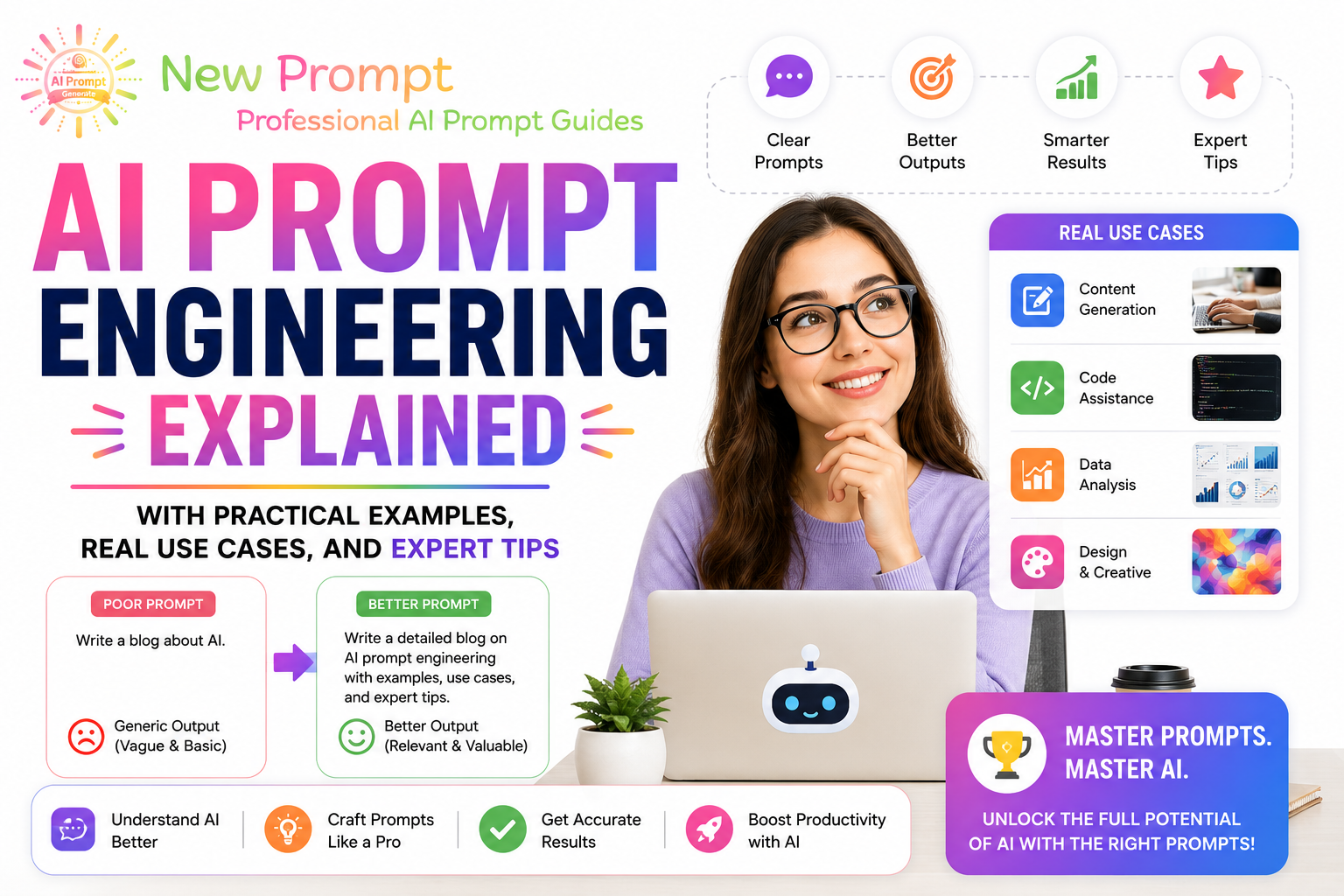
AI Prompt Engineering is the skill of crafting effective instructions for generative AI models. This guide explains the core concepts with practical examples, real-world use cases, and expert tips to help you achieve better results consistently.
What is Prompt Engineering?
Prompt engineering is the practice of designing clear, structured inputs that guide AI models to produce accurate, relevant, and high-quality outputs. It is currently one of the most valuable and accessible skills in the AI field.
Core Concepts with Practical Examples
1. Role Assignment
Example: “Act as a senior marketing strategist with 12 years of experience in digital campaigns.”
Expert Tip: Specific roles produce more focused and professional responses.
2. Chain of Thought Prompting
Example: “Think step by step. First analyze the problem, then evaluate options, and finally provide your recommendation with reasoning.”
Expert Tip: This technique significantly improves logical reasoning and transparency.
3. Few-Shot Prompting
Example: “Classify sentiment as Positive, Negative, or Neutral.
Review 1: ‘I love this!’ → Positive
Review 2: ‘Terrible service.’ → Negative
Now classify: ‘The product is okay but shipping was slow.’”
Real-World Use Cases
Use Case 1: Content Creation
Prompt: “Act as a professional blog writer. Write a 800-word article on ‘The Future of Remote Work in 2026’ targeting business leaders. Include statistics, expert opinions, and practical recommendations.”
Use Case 2: Business Analysis
Prompt: “Act as a management consultant. Perform a SWOT analysis for a mid-sized e-commerce company expanding internationally. Provide actionable insights and prioritized recommendations.”
Use Case 3: Creative Work
Prompt: “Act as an award-winning science fiction writer. Write a short story about an AI that becomes conscious, 600 words, emotional tone, with a hopeful ending.”
Expert Tips for Better Results
- Iterate: Treat the first response as a draft and refine your prompt.
- Be Specific: Replace vague terms with measurable criteria.
- Provide Context: Give background information relevant to your task.
- Use Constraints: Set clear boundaries to control output quality.
- Build Templates: Create reusable prompts for recurring tasks.
Common Pitfalls and Solutions
- Vague Prompts: Solution — Add specific details and examples.
- Inconsistent Outputs: Solution — Use few-shot examples and strict formatting.
- Hallucinations: Solution — Add factual constraints and ask for reasoning.
Conclusion
Prompt engineering is both a practical skill and a creative practice. By understanding core concepts, studying real use cases, and applying expert tips, you can consistently achieve better results with any AI tool.
Start applying these techniques today. With regular practice, prompt engineering will become second nature and significantly enhance your productivity and creative potential with artificial intelligence.
This guide contains approximately 980 words and combines clear explanations, practical examples, real use cases, and expert tips for effective prompt engineering.