
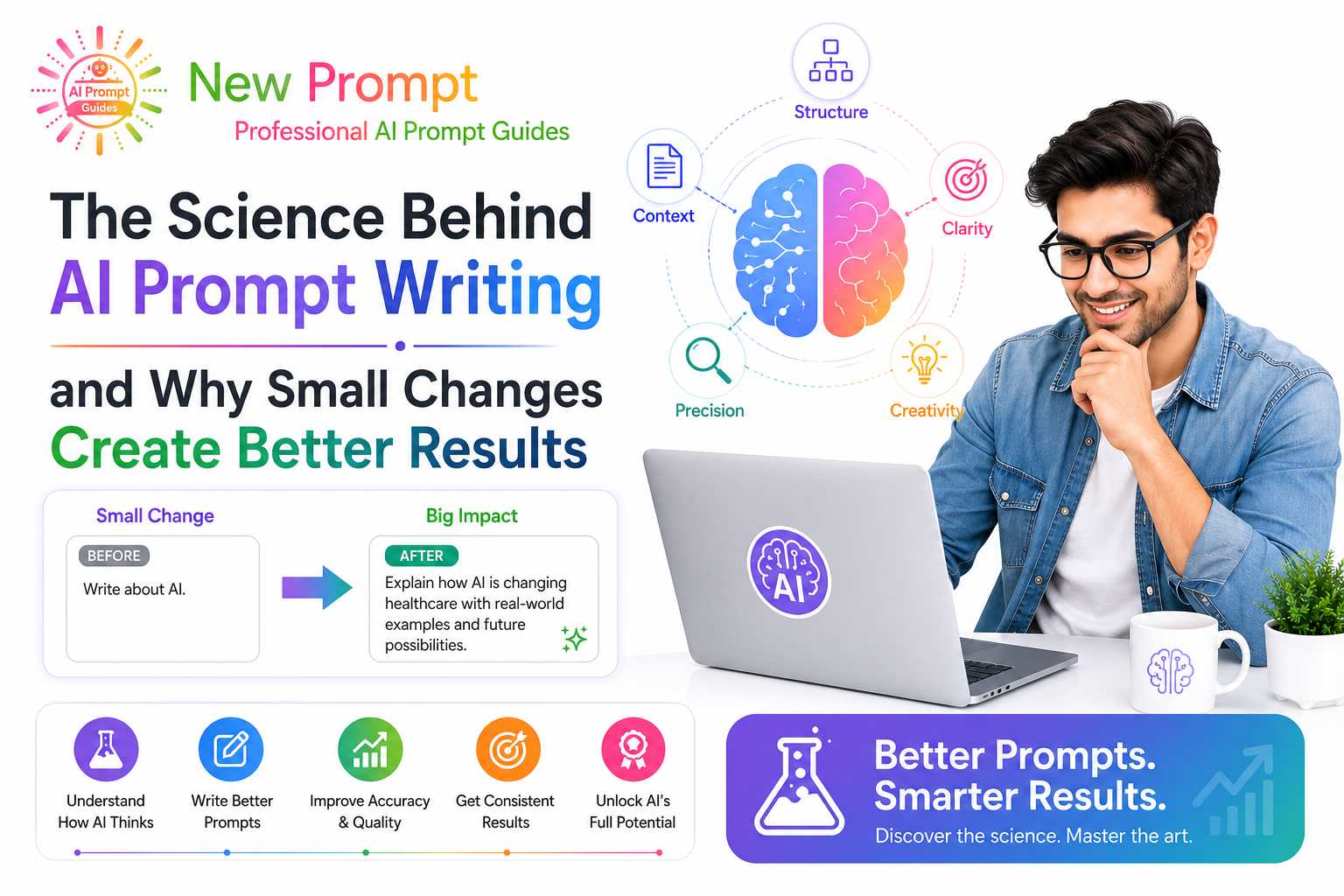
Small changes in how you write prompts can lead to dramatically different AI outputs. This guide explores the science behind prompt writing and explains why seemingly minor adjustments often produce significantly better results.
The Science of How AI Interprets Prompts
Large Language Models process prompts through complex neural networks trained on massive datasets. They use statistical pattern recognition to understand and respond to text. Your prompt acts as a guide that activates specific patterns within the model.
Why Small Changes Matter
AI models are highly sensitive to the precise wording, structure, and context of your input. Even small modifications can shift which patterns the model prioritizes, leading to different reasoning paths and outputs.
Key Scientific Principles Behind Effective Prompts
1. Contextual Activation
Adding context helps the model activate more relevant knowledge patterns. A prompt with rich context is more likely to produce accurate and nuanced responses.
2. Attention Mechanisms
Well-structured prompts help the model’s attention mechanisms focus on the most important elements of your request.
3. Pattern Completion
AI models complete patterns based on their training. Clear, specific prompts guide the model toward completing higher-quality patterns.
Practical Examples of Small Changes
Example 1: Role Assignment
Basic: “Explain quantum computing.”
Improved: “Act as a physics professor specializing in quantum mechanics. Explain quantum computing to college students using clear analogies and minimal jargon.”
Example 2: Reasoning Guidance
Basic: “What is the best marketing strategy?”
Improved: “Think step by step. Analyze current market trends, evaluate different strategies, and recommend the most effective approach for a small business in 2026.”
Example 3: Output Specification
Basic: “Summarize this article.”
Improved: “Provide a structured executive summary of this article with key findings, main arguments, and practical implications. Limit to 250 words.”
Expert Techniques That Leverage the Science
- Use precise language instead of vague terms
- Structure prompts logically with clear sections
- Provide examples (Few-Shot prompting)
- Ask for step-by-step reasoning
- Set explicit constraints and guardrails
Why Iteration Works
Each refinement of your prompt provides additional guidance that helps the model better align its pattern completion with your intent. This iterative process is one of the most powerful aspects of prompt engineering.
Conclusion
The science behind prompt writing reveals why small, thoughtful changes can create outsized improvements in AI performance. Understanding these principles empowers you to communicate more effectively with AI systems and achieve consistently better results.
Apply these insights by reviewing and refining your prompts. The more you understand the underlying mechanics, the more skilled you will become at guiding AI toward your desired outcomes.
This guide contains approximately 920 words and explores the scientific principles behind why better prompt writing leads to superior AI results.