
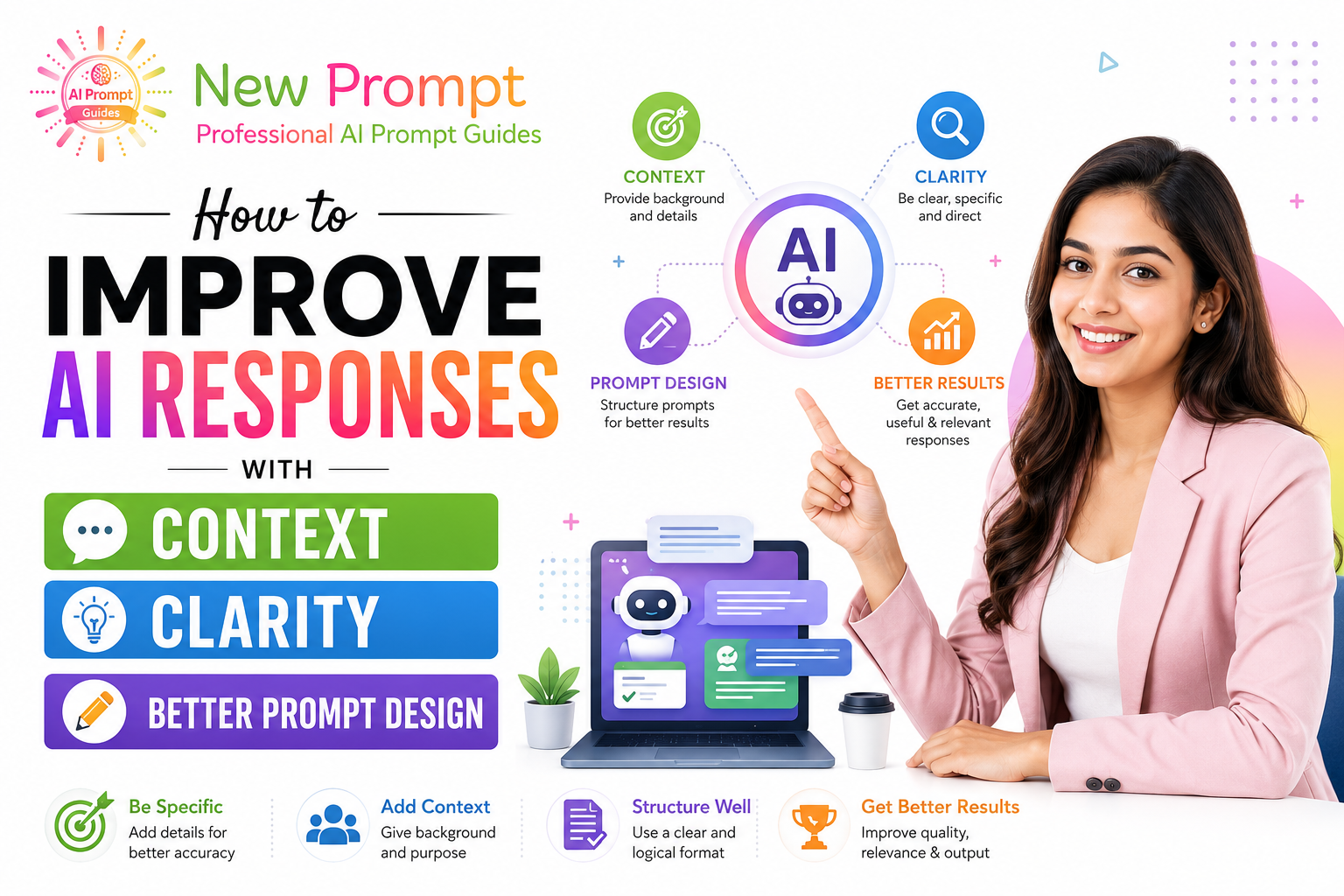
The quality of AI responses depends primarily on three key elements: context, clarity, and prompt design. This guide explains how to leverage these factors to achieve consistently better results from AI tools.
The Power of Context
Providing rich context helps the AI understand your specific situation and needs. Without context, responses tend to be generic or misaligned with your goals.
How to Add Effective Context
- Describe your background or situation
- Mention your goals and constraints
- Include relevant details about the audience or use case
- Specify timeframes or scope
The Importance of Clarity
Clear language eliminates ambiguity and helps the AI focus on what matters most.
Techniques for Greater Clarity
- Use precise and specific wording
- Avoid vague terms like “good” or “interesting”
- Break complex requests into clear parts
- Use simple, direct sentences
Better Prompt Design Principles
1. Role Assignment
Start with “Act as a…” or “You are a…” to set expertise and tone.
2. Structured Output Requests
Explicitly define the desired format, length, and organization.
3. Chain of Thought Guidance
Ask the AI to reason step by step for better logical outputs.
4. Constraint Setting
Define boundaries such as word count, style, or prohibited elements.
Practical Before-and-After Examples
Weak Prompt:
“Help me with my business plan.”
Strong Prompt:
“Act as a senior business consultant with expertise in startups. Help me develop a comprehensive business plan for a sustainable coffee subscription service targeting urban professionals aged 25-40. Provide sections for Executive Summary, Market Analysis, Product Strategy, Marketing Plan, and Financial Projections. Use professional tone and include realistic assumptions.”
Expert Tips for Continuous Improvement
- Review each response and identify areas for improvement
- Refine prompts iteratively rather than accepting the first output
- Build a library of successful prompt structures
- Test the same prompt across different AI models
Conclusion
Improving AI responses through better context, clarity, and prompt design is a learnable skill that delivers immediate benefits. By applying the principles in this guide, you can transform average AI outputs into accurate, useful, and valuable results.
Start focusing on these three elements today. The more intentional you become with your prompt design, the more impressive and reliable your AI interactions will become.
This guide contains approximately 950 words and focuses on practical methods to improve AI responses through context, clarity, and better prompt design.